

Introduction to Word Counter
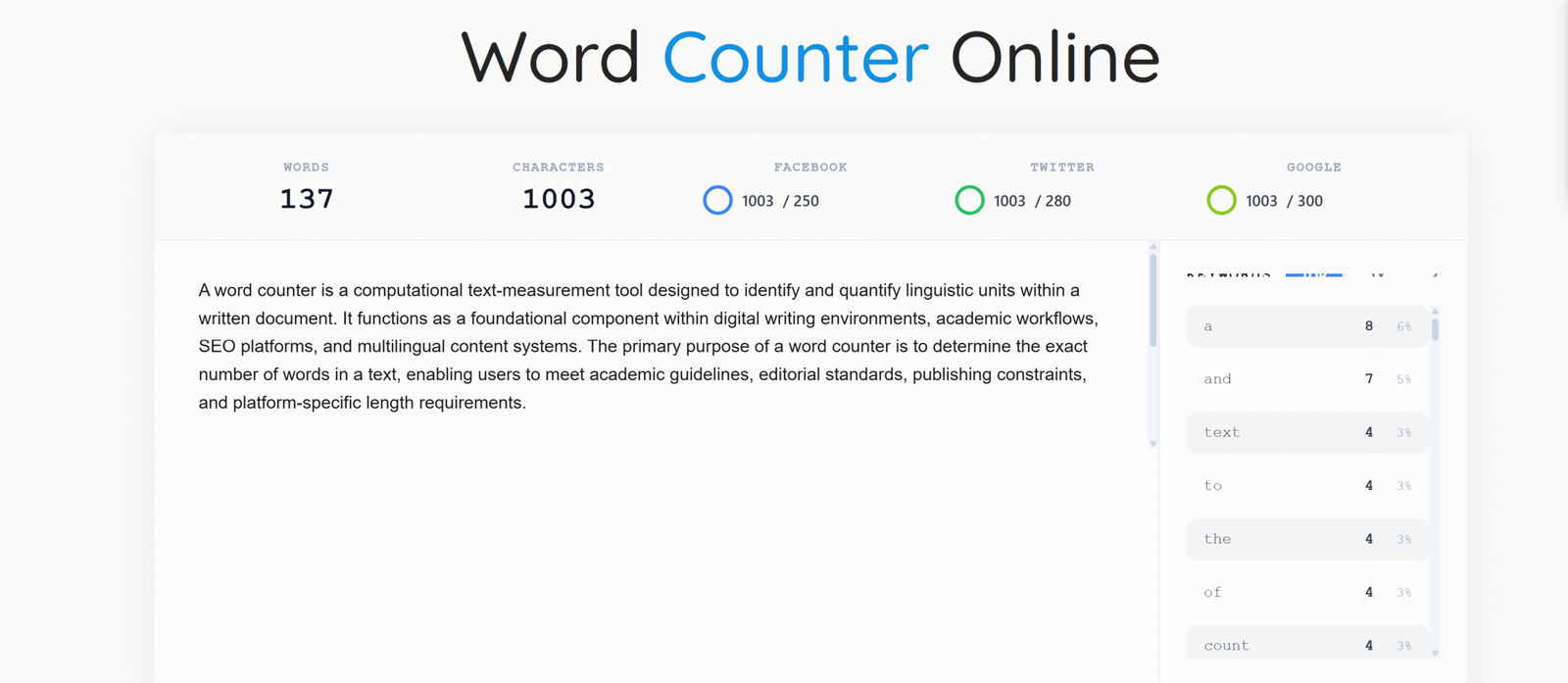
A word counter is a computational text-measurement tool designed to identify and quantify linguistic units within a written document. It functions as a foundational component within digital writing environments, academic workflows, SEO platforms, and multilingual content systems. The primary purpose of a word counter is to determine the exact number of words in a text, enabling users to meet academic guidelines, editorial standards, publishing constraints, and platform-specific length requirements.
Modern text-analysis systems connect the word counter to a broader network of quantitative metrics that describe the structural and semantic attributes of writing. These include character count, reading time, keyword density analysis, sentence count, paragraph count, and line count, each offering a distinct analytical perspective on text organisation and complexity. Together, these measurements help determine content suitability for search engines, user experience, and readability benchmarks.
Advanced implementations such as those developed for WordCounter.pk extend functionality to deeper linguistic indicators like unique words, longest word, average word length, average sentence length, readability score, and speaking time. These metrics support vocabulary profiling, comprehension assessment, oral delivery estimation, and overall text optimisation across academic, professional, and AI-driven environments. As a result, a word counter operates not only as a basic counting tool but as an integrated text-analytics engine designed for precision, accessibility, and semantic clarity.
Historical Context
Evolution of Text Measurement Tools
The origins of the word counter can be traced to early editorial practices, when text measurement depended on manual methods from early proofreading. Editors evaluated word length and page density by hand, using rulers, fixed-font typewriters, and line-by-line inspection. These processes were slow, prone to human error, and relied heavily on typographic conventions rather than linguistic precision.
With the rise of personal computing, text measurement entered a new phase through the integration into word processors. Software environments began embedding automatic counting functions to support writers, students, and publishers. Key applications such as Microsoft Word and Google Docs standardised built-in text statistics, enabling instant calculation of words, characters, lines, sentences, and pages.
The widespread use of the internet and browser-based productivity tools accelerated this evolution further, leading to the emergence of online tools such as Microsoft Word, Google Docs, and modern online word counters. Contemporary platforms like WordCounter.pk offer real-time analysis, advanced linguistic metrics, multi-language support, and AI-aligned text evaluation. These tools operate independently of device or software, providing accessible and accurate measurement for global users across academic, professional, and digital publishing environments.
Core Functionality
Standard Counting Features
A modern word counter provides a structured set of foundational metrics that define the quantitative profile of any written text. These standard counting features serve as the baseline for academic assessment, editorial compliance, digital publishing, and algorithmic text analysis. Each metric represents a distinct textual unit, enabling users to evaluate structure, density, and composition with precision.
- Word count
The primary measurement that identifies the total number of words within a document. It is essential for meeting assignment limits, publishing requirements, SEO guidelines, and platform-specific constraints. - Character count with spaces
This metric includes every character letters, numbers, symbols alongside spaces. It is especially important for social media posts, advertising copy, subtitles, UX microcopy, and systems with strict character thresholds. - Character count without spaces
A refined measurement that excludes whitespace to provide a clearer estimate of textual density. This count is useful for programming contexts, metadata optimisation, and compact layout design. - Sentence count
The total number of sentences in a text, used to assess syntactic structure, pacing, readability, and linguistic complexity. Sentence distribution influences readability scores and user comprehension. - Paragraph count
A structural metric indicating the division of content into paragraphs. It helps analyse coherence, thematic organisation, and the visual layout of long-form writing. - Line count
A measurement tied to formatting and display, especially in poetry, screenplays, scripts, coding files, and manuscript preparation. Line-based analysis supports typographic layout and platform-specific export standards.
Together, these standard counting features form the analytical foundation on which more advanced metrics like readability scoring, keyword density, and linguistic profiling—are built, enabling WordCounter.pk to deliver comprehensive text evaluation across diverse writing environments.
Advanced Analytical Features
Beyond fundamental text measurements, a modern word counter incorporates a suite of advanced analytical features designed to evaluate linguistic richness, structural balance, cognitive difficulty, and time-based delivery. These metrics transform basic counting into a comprehensive text-intelligence system, enabling deeper insights into vocabulary diversity, sentence construction, and user experience across academic, professional, and digital environments.
- Unique words
This metric identifies the total number of distinct lexical items within a text. A higher count indicates greater vocabulary diversity, which is valuable for academic writing, creative composition, and readability optimisation. - Longest word
Detects the lengthiest lexical unit in the document. This feature is useful for linguistic analysis, complexity evaluation, and ensuring that excessively long technical terms or compound words do not impede accessibility. - Average word length
Calculates the mean number of characters per word, offering insight into the density and difficulty of the vocabulary. Shorter averages generally correlate with simpler, more readable content. - Average sentence length
Measures the mean number of words in each sentence. This is a critical indicator of structural clarity, influencing readability scores and comprehension levels across various audiences. - Readability score
A computational assessment of how easily a text can be read and understood. Tools often incorporate established formulas (e.g., Flesch–Kincaid), helping writers match their content to target reading levels or institutional guidelines. - Reading time
Estimates how long an average person would take to read the text. This feature is essential for blog posts, articles, e-learning material, and accessibility-focused content planning. - Speaking time
Calculates the approximate duration required to verbally deliver the text. It is particularly useful for presentations, speeches, podcasts, video scripts, and educational lectures.
These advanced analytical features convert simple text measurement into multidimensional analysis, enabling WordCounter.pk to support precision writing, content strategy, and AI-aligned text evaluation with accuracy and depth.
Applications
Academic Use
In academic environments, a word counter functions as an essential tool for maintaining compliance with institutional writing standards. Most educational assignments specify precise length expectations, including assignment constraints and metrics that determine minimum or maximum word requirements. These constraints help evaluate a student’s ability to communicate ideas concisely, develop arguments thoroughly, and adhere to formal academic structure.
Students use a word counter to verify that their essays, reports, theses, and research papers fall within the required limits before submission. Metrics such as word count, character count, sentence structure, and paragraph distribution help ensure clarity, balance, and coherence throughout the document.
Academic integrity systems also rely on integrated measurement tools. Platforms and plagiarism-detection services most notably Turnitin provide automated word and character metrics within their analysis reports. These metrics support instructors in assessing text originality, evaluating writing volume, and verifying compliance with institutional or journal-specific guidelines.
Through these combined functions, a word counter enables students, educators, and researchers to meet academic expectations while maintaining precision, readability, and adherence to scholarly standards.
SEO & Content Marketing
In digital marketing, a word counter plays a central role in evaluating content suitability for search engines, user intent, and platform-specific ranking factors. One of the most significant applications is long-form optimisation, where writers and SEO professionals determine whether an article meets the depth, scope, and topical coverage required to compete in search results. Longer, well-structured content often performs better because it provides comprehensive answers and increases semantic relevance.
A modern SEO workflow also depends heavily on semantic structure, ensuring that text is organised into meaningful hierarchies of headings, entities, and contextual relationships. By analysing sentence length, paragraph distribution, and structural balance, a word counter helps map content to search engine expectations for clarity, coherence, and topic completeness.
Additionally, keyword density considerations remain fundamental to content optimisation. While keyword stuffing is discouraged, maintaining an appropriate ratio of target and supporting terms enhances NLP alignment and improves search visibility. A word counter measures the frequency and distribution of keywords within the text, helping writers maintain natural usage while ensuring that essential terms are neither underrepresented nor overused.
In SEO and content marketing ecosystems, these combined metrics enable precise content calibration supporting higher rankings, improved user engagement, and stronger alignment with modern search algorithms.
Social Media Limitations
In the context of social media, a word counter is a critical tool for ensuring that content adheres to platform-specific constraints. Platforms such as Twitter, Instagram, LinkedIn impose strict limits on character counts for posts, captions, headlines, and comments. Exceeding these limits can result in truncated messages, reduced engagement, or even rejection by the platform’s interface.
To navigate these restrictions, content creators rely on character counters to measure the exact length of their text, including spaces, punctuation, and emojis. These tools help writers craft messages that are concise, readable, and optimized for user interaction while remaining within platform guidelines. For example, Twitter’s evolving character policy requires frequent monitoring to maintain compliance, whereas Instagram and LinkedIn posts may need adjustments to suit both display and algorithmic visibility.
By integrating word counter and character counter functionalities, tools like WordCounter.pk empower social media managers, marketers, and influencers to produce content that is platform-ready, engaging, and precise maximizing reach and maintaining brand consistency across multiple channels.
Publishing Industry
In the publishing industry, a word counter is an indispensable tool for authors, editors, and production teams to maintain precision in manuscript preparation. Whether drafting novels, short stories, essays, or journal articles, writers must often adhere to strict word limits or target ranges specified by publishers, literary agents, or style guides. By tracking word totals, sentence distribution, and paragraph structure, a word counter ensures that content meets editorial standards before submission or review.
Another key application is word-per-page modelling, which helps estimate the physical layout and length of printed or digital material. This metric allows publishers to anticipate page count, font sizing, spacing, and overall formatting requirements, ensuring consistency across editions and facilitating efficient printing or digital display. Accurate word-per-page calculations also assist in budgeting, scheduling, and aligning content with audience expectations for reading time and accessibility.
By providing precise measurement and structural insights, a word counter supports the publishing workflow from manuscript creation to final production, enabling authors and editors to maintain quality, clarity, and compliance with industry standards.
Related Features
Modern word counters extend beyond simple counting to offer a suite of related features that enhance text analysis, writing quality, and content optimisation. These advanced functionalities support academic, professional, and digital content workflows, making tools like WordCounter.pk essential for comprehensive text evaluation.
- Text summarisation
Automatically condenses content to highlight key points and main ideas, aiding in research, content review, and executive briefings. - Plagiarism detection
Identifies duplicated or unoriginal content to maintain academic integrity and avoid copyright infringement. - Grammar correction
Detects and suggests corrections for syntactic errors, improving readability, clarity, and professionalism. - Spell check
Highlights misspellings and common typographical errors to ensure accurate and polished writing. - Passive voice detection
Identifies sentences written in the passive voice, helping writers maintain active, engaging, and concise prose. - Lexical diversity measurement
Evaluates the variety of vocabulary used in a text, providing insights into richness, originality, and linguistic complexity. - Flesch–Kincaid readability test
Calculates reading difficulty based on sentence and word length, assisting writers in tailoring content to target audiences. - Stop-word filtering
Identifies and optionally removes common words that may skew keyword analysis or search engine optimisation metrics. - Lemmatization
Reduces words to their base or dictionary forms, supporting linguistic analysis, semantic search, and NLP applications. - Stemming
Strips words to their root forms to facilitate text mining, search indexing, and content clustering.
These related features transform a word counter from a simple counting tool into a comprehensive text-analysis platform, enabling writers, editors, and marketers to refine content, optimise readability, and support advanced SEO and NLP applications.
Platform Integration
A modern word counter is designed to be highly versatile, supporting a wide range of platforms and user environments. This platform integration ensures that writers, editors, marketers, and developers can access accurate text measurement tools wherever they work, whether on desktop, mobile, or cloud-based systems. WordCounter.pk exemplifies this approach by offering seamless integration across multiple formats.
- Browser-based tools
Accessible directly through web browsers without installation, these tools provide instant word count, character count, and advanced analytics for real-time text evaluation. - Mobile apps
Enable on-the-go writing and editing, allowing users to track metrics such as reading time, sentence count, and paragraph count from smartphones or tablets. - Browser extensions
Integrate word counter functionality directly into web pages, online editors, and content management systems, offering instant feedback while writing or editing. - WordPress plugins
Embed counting and analysis features directly into WordPress dashboards, supporting content creators in SEO optimisation, blog management, and editorial compliance. - API services
Allow developers to integrate word counter functionality into custom applications, automated workflows, and AI-driven content platforms. - Google Docs Add-ons
Enhance the native Google Docs experience with advanced text analytics, including keyword density analysis, readability scoring, and real-time word tracking. - CMS modules
Integrate counting and analysis features into content management systems, streamlining editorial workflows, ensuring compliance with length restrictions, and improving semantic structure.
Through these diverse integrations, a word counter becomes a flexible, omnipresent tool that supports text evaluation across multiple environments—empowering users to optimise content efficiently and maintain precision wherever they create or publish
Internationalisation
Globalisation of content and the rise of multilingual digital publishing have made internationalisation an essential feature for any modern word counter. Platforms like WordCounter.pk cater to a wide range of languages and writing systems, ensuring accurate word and character measurements, semantic analysis, and readability evaluation across diverse linguistic contexts. Handling multilingual text requires sophisticated tokenisation, script-aware algorithms, and consideration for script-specific rules, making internationalisation critical for academic, professional, and SEO-oriented content worldwide.
- Urdu word counter
The Urdu word counter addresses the unique challenges of the Urdu script, which includes contextual letter forms, ligatures, and diacritics. Proper tokenisation is essential because words may change shape depending on their position within a sentence. This ensures accurate word count, sentence count, and paragraph analysis for academic papers, blog posts, and social media content in Urdu. - Arabic word counter
Arabic is a right-to-left (RTL) language with complex morphology, including root-and-pattern structures and contextual letter forms. The Arabic word counter accurately identifies word boundaries, measures characters with or without spaces, and maintains correct line count and paragraph metrics in RTL orientation. It is particularly important for SEO content, digital marketing, and professional publishing in Arabic-speaking regions. - Hindi word counter
Hindi, written in the Devanagari script, presents unique challenges such as compound words, matras (diacritical marks), and conjunct consonants. A dedicated Hindi word counter accounts for these script-specific rules, ensuring precise word count, character count, and readability scoring. This supports academic work, e-commerce content, and multilingual blogging. - Chinese character counter
Chinese writing is logographic, meaning each character may represent a word or concept. A specialized Chinese character counter provides accurate metrics for character count, line count, and reading time estimation, which is crucial for SEO optimisation, digital content creation, and translation projects. - Right-to-left text counting
Many scripts, including Arabic, Urdu, Persian, and Hebrew, are written right-to-left. Accurate right-to-left text counting requires algorithms that respect directional flow while correctly calculating word count, sentence count, and paragraph metrics. This feature ensures consistency in multilingual documents, maintaining semantic integrity for professional, academic, and digital publishing applications.
By offering these internationalisation capabilities, a word counter transforms from a simple text measurement tool into a robust multilingual text-analysis platform. It enables writers, marketers, researchers, and developers to produce globally accessible content while maintaining precise metrics, semantic clarity, and compliance with language-specific conventions.
Technical Aspects
Accurate text measurement in a word counter depends on a series of technical aspects that govern how words, characters, and symbols are identified and calculated. These aspects are critical for maintaining precision across different languages, formats, and content types, making platforms like WordCounter.pk reliable for academic, professional, and digital content analysis.
- Whitespace handling
Proper detection of spaces, tabs, and line breaks is fundamental for accurate word count and sentence count. Whitespace handling also affects paragraph metrics, line count, and character calculations, ensuring that formatting does not artificially inflate or reduce text measurements. - Hyphenation rules
Words joined with hyphens, such as “state-of-the-art” or compound technical terms, require careful treatment. A word counter applies hyphenation rules to determine whether such sequences are counted as single words, multiple words, or phrases, maintaining consistency across style guides and linguistic standards. - Contraction treatment
Contractions like “don’t,” “can’t,” or “they’re” pose challenges for tokenisation and unique word calculations. Advanced word counters handle contractions by either treating them as single lexical units or splitting them into constituent words, depending on context and analytical requirements. - Emoji and Unicode support
Modern content often includes emojis, symbols, and international characters encoded in Unicode. A word counter with full Unicode support can measure these elements accurately for character count, reading time estimation, and semantic analysis. This is particularly important for social media content, messaging, and multilingual platforms. - Punctuation processing
Correct identification and handling of punctuation marks affect sentence parsing, sentence count, and average sentence length calculations. This includes periods, commas, quotation marks, ellipses, and other symbols that signal syntactic boundaries. Proper punctuation processing ensures accurate readability scores, text analytics, and natural language processing (NLP) alignment.
By addressing these technical aspects, a word counter achieves precise measurement and robust text analysis. These underlying mechanisms enable WordCounter.pk to deliver reliable results for diverse content types, multilingual text, and complex digital formats, forming the backbone of professional, academic, and SEO-oriented writing workflows.
Limitations
While a word counter is a powerful tool for measuring and analysing text, certain inherent limitations can affect accuracy and interpretation. Understanding these constraints is essential for academic, professional, and digital content creators who rely on platforms like WordCounter.pk for precise metrics.
- Overcounting due to formatting
Text formatting such as line breaks, tables, bullet points, footnotes, or hidden characters can cause a word counter to overestimate the actual word count. For example, words in headers, footers, or repeated metadata may be included in totals, leading to inflated character count, sentence count, or paragraph count. - Mismatched language tokenisation
Different languages follow distinct rules for word boundaries, punctuation, and scripts. Tokenisation algorithms may misinterpret word separations in languages with compound words, right-to-left orientation, or logographic characters, resulting in inaccurate unique words, average word length, or line count. - Unintentional keyword stuffing
In SEO and content marketing, repeated keywords may be counted excessively without distinguishing between natural usage and artificial repetition. This can lead to misleading keyword density analysis and affect content optimisation, particularly when relying solely on automated tools.
Despite these limitations, modern word counters including WordCounter.pk mitigate inaccuracies through advanced algorithms, multilingual support, and context-aware tokenisation. Awareness of these constraints allows writers, editors, and marketers to interpret metrics accurately, maintain semantic integrity, and optimise content for both human readers and search engines.
Comparison with Other Tools
In the landscape of digital writing and content optimisation, a word counter forms a foundational component that complements a variety of specialized writing tools. While platforms like WordCounter.pk focus on precise word count, character count, and advanced text analytics, understanding how it compares with other popular solutions highlights its strengths, limitations, and integration potential.
1. Grammarly
Grammarly is primarily a grammar and style assistant, offering suggestions for punctuation, syntax, tone, and clarity. While it provides word count and readability scores, its core functionality emphasises writing correction rather than detailed keyword density analysis or multilingual word counting. WordCounter.pk complements Grammarly by providing precise quantitative metrics for SEO, academic, and publishing purposes.
2. Hemingway Editor
Hemingway Editor focuses on readability enhancement, highlighting passive voice, complex sentences, and adverbs. Although it estimates sentence complexity and reading time, it does not provide extensive paragraph count, line count, or character count without spaces. WordCounter.pk offers these measurements along with deeper text analytics for comprehensive content evaluation.
3. QuillBot
QuillBot is an AI-based paraphrasing and summarization tool that assists with rewriting content for clarity or originality. While it can process text and suggest rewording, it lacks precise unique word tracking, longest word identification, and structured text analytics available in a full-featured word counter.
4. Jasper
Jasper is an AI content generation platform optimised for marketing and SEO. It can create blog posts, social media content, and ad copy. However, metrics like sentence count, paragraph count, reading time, and speaking time are secondary, making WordCounter.pk a more specialised tool for analytical measurement of generated content.
5. SEMrush Writing Assistant
SEMrush Writing Assistant evaluates SEO optimisation, readability, and target keywords within content. While it provides some keyword density analysis and SEO scoring, WordCounter.pk offers more granular control over word count, character count, line count, and advanced linguistic metrics such as lexical diversity and average sentence length.
6. Ahrefs Content Checker
Ahrefs content checker primarily focuses on SEO performance, backlinks, and content optimisation for search engines. Although it provides guidance for content length and keyword use, it does not offer real-time reading time, speaking time, or multi-language support. WordCounter.pk complements this by providing precise, multilingual, and structurally detailed metrics for writers and marketers.
This comparison demonstrates that while these tools offer specialised functionality—such as grammar correction, AI generation, or SEO optimisation a comprehensive word counter like WordCounter.pk provides foundational, precise, and multilingual text analytics that enhance readability, SEO performance, and content strategy.
Related Tools and Concepts
In addition to core word counter functionality, several related tools and computational linguistics concepts enhance text analysis, writing efficiency, and content optimisation. Understanding these complementary tools helps writers, marketers, educators, and developers integrate word count metrics into broader workflows, improving productivity, SEO, and semantic accuracy.
1. Writing and Productivity Tools
- Typing speed test – Measures words per minute (WPM), helping writers monitor efficiency and practice accuracy in real-time.
- Online notepad – A lightweight writing environment for drafting, editing, and preliminary word count tracking without complex software.
- Text editor – Provides basic to advanced text formatting and editing, often including built-in word count and character metrics for efficient content preparation.
2. Computational Linguistics and NLP
- Natural language processing (NLP) A field that enables machines to analyse, interpret, and generate human language. Integrating word counters with NLP supports semantic analysis, entity recognition, and syntactic evaluation.
- Text mining – The extraction of meaningful patterns and insights from large text corpora. Word count, unique word metrics, and lexical diversity are foundational measures in text mining workflows.
- Machine translation – Automated translation systems that rely on accurate tokenisation and word count for preserving meaning across languages.
- Corpus linguistics – The study of language based on structured collections of texts. Metrics such as word frequency, average sentence length, and unique words support corpus analysis and linguistic research.
3. SEO and Content Optimisation Tools
- Search engine optimisation (SEO) – A practice that benefits from keyword density analysis, content length measurement, and semantic structure insights provided by a word counter.
- SEO writing assistant – A tool for optimising content according to SEO standards, often integrating word count, readability scores, and keyword tracking.
- Content brief generator – Automates the creation of structured writing guides, leveraging word count, topic clusters, and semantic metrics for efficient content planning.
- Document analyser – Offers in-depth analysis of text properties, including character count, paragraph count, reading time, and linguistic complexity.
By connecting a word counter to these related tools and concepts, WordCounter.pk supports a holistic content creation ecosystem. Writers, researchers, and marketers can measure, analyse, and optimise text effectively while integrating advanced NLP, SEO, and productivity workflows.
Extended Feature Set H2
The modern word counter ecosystem extends far beyond basic word and character measurement, offering a comprehensive extended feature set that supports writers, marketers, educators, and developers in managing, analysing, and optimising content. These advanced capabilities are essential for real-time monitoring, goal tracking, multi-document workflows, and AI-driven text evaluation, positioning platforms like WordCounter.pk as a holistic text-analysis solution.
Real-Time & Goal-Based Analysis
This category focuses on live tracking, goal management, and automated evaluation, enabling writers to monitor progress and maintain productivity:
- Real-time word tracking – Continuously updates word count as the user types, allowing for instant feedback on document length and pacing.
- Word count milestones – Enables users to set incremental targets for writing sessions, supporting structured workflows and motivational goal-setting.
- Automatic text evaluation – Performs ongoing analysis of text metrics, including sentence count, paragraph count, unique words, and reading time, providing immediate insights into document composition.
- Editable word goals – Allows writers to define minimum or maximum limits for content projects, ensuring compliance with assignment criteria, editorial guidelines, or platform requirements.
- Multi-document analysis – Aggregates metrics across multiple files or documents, supporting large-scale projects such as research papers, content series, or corporate documentation.
- Content expansion planning – Identifies sections that require additional elaboration based on word count, sentence structure, and readability metrics, assisting in long-form content optimisation for SEO and user engagement.
This real-time and goal-based feature set transforms a word counter from a static measurement tool into an interactive productivity and content strategy platform, enabling writers to maintain control, improve efficiency, and achieve precision across diverse text projects.
Language & Symbol-Level Metrics
Advanced word counters extend their functionality to language and symbol-level metrics, providing granular insights into textual composition. These features are critical for multilingual content, technical writing, coding, and precise formatting, ensuring that every linguistic and symbolic element is accurately analysed.
- Language-specific counting
Tailors word count and character count algorithms to accommodate the unique rules of different languages. This includes handling right-to-left scripts, logographic characters, and complex morphology to ensure accurate measurement in Urdu, Arabic, Hindi, Chinese, and other languages. - Alphabet frequency
Measures the occurrence of each individual letter within a text. This metric is valuable for linguistic analysis, cryptography, typography design, and studying letter distribution patterns in various languages. - Digit count tool
Counts numeric characters within a document, supporting tasks such as technical documentation, scientific writing, and data-driven content analysis where numeric accuracy is essential. - Symbol counter
Identifies and counts special characters and symbols, including mathematical operators, emojis, or domain-specific markers. This helps in content validation, social media compliance, and formatting checks. - Punctuation counter
Analyses the frequency and placement of punctuation marks such as periods, commas, colons, and semicolons. This is essential for sentence parsing, readability scoring, and syntactic analysis. - Tab spacing count
Calculates tab characters and spacing usage, aiding in formatting consistency for coding files, manuscripts, and structured documents where indentation impacts readability and layout.
By incorporating language and symbol-level metrics, a word counter like WordCounter.pk provides comprehensive insights into text structure, enabling writers, editors, and developers to maintain precision, compliance, and semantic clarity across diverse writing contexts.
Inline, Batch & Structured Data Counting
Modern word counters extend functionality to handle inline text, batch processing, and structured data formats, allowing for large-scale content analysis, technical workflows, and automation. These capabilities are essential for writers, developers, marketers, and researchers who manage diverse digital content.
- Inline text analytics
Provides immediate, in-place analysis of text as it is written or edited, delivering word count, character count, and readability metrics in real time without disrupting workflow. - Batch file counter
Processes multiple documents simultaneously, aggregating word count, sentence count, and paragraph metrics across files. Ideal for research projects, bulk content audits, or editorial reviews. - Email body word count
Measures the length of email content to ensure compliance with corporate communication standards, marketing campaigns, and professional correspondence. - Forum post length
Analyses user-generated content on forums, discussion boards, and community platforms to monitor compliance with platform restrictions and engagement guidelines. - Comment length checker
Evaluates comments on blogs, social media, or knowledge-sharing platforms to enforce moderation standards, readability, and conciseness. - JSON text counter
Parses structured JSON files to count words and characters within textual fields, supporting software documentation, API content analysis, and technical writing. - XML character analysis
Provides precise character count and word analysis within XML nodes and attributes, critical for structured data validation, publishing, and semantic content extraction. - Terminal word counter
Offers command-line interface (CLI) support for developers and system administrators to perform text measurement and reporting within scripts or automation pipelines. - Word count automation
Integrates counting functionality into workflows to automatically monitor, report, and enforce word count and structural metrics across projects, enabling efficiency in editorial, technical, and SEO operations.
By supporting inline, batch, and structured data counting, a word counter like WordCounter.pk becomes a versatile tool for diverse use cases, from coding and technical content analysis to bulk editorial management and automated workflow optimisation.
Headline & Display-Limited Text
In digital content creation, especially for marketing, UX, and social media, managing headline and display-limited text is essential for engagement, readability, and platform compliance. Advanced word counters provide specialised tools to optimise concise content while maintaining semantic and structural accuracy.
- Headline text limiter
Ensures that titles, headings, and promotional text adhere to platform-specific character and word limits. This feature is crucial for SEO-optimised blog headings, ad copy, social media posts, and email subject lines, helping maintain visibility and user engagement without truncation. - Character weight calculator
Analyses the visual or semantic impact of characters within limited-space content. This tool helps writers prioritise concise, high-value words for headlines, captions, or interface text, optimising clarity, comprehension, and reader retention.
By incorporating these features, a word counter like WordCounter.pk allows content creators to efficiently craft headline and display-limited text that is both precise and impactful, supporting SEO, marketing, and UX objectives across multiple digital platforms.
Writing Systems & Productivity Tools
Modern word counters integrate writing systems and productivity tools to support structured workflows, long-form content creation, and AI-assisted text evaluation. These features enable writers, students, and content marketers to track progress, maintain consistency, and optimise documents for readability, length, and semantic clarity.
- Writing habit tracker
Monitors daily or session-based writing activity, recording word count, sentence metrics, and time spent writing. This feature encourages consistency, helps establish productivity routines, and provides insights into writing patterns over time. - Long-form drafting tool
Assists writers in structuring, composing, and managing extended content such as research papers, e-books, and comprehensive blog posts. By tracking paragraph count, sentence length, and overall word count, it ensures content remains coherent and meets target length requirements. - AI text length audit
Uses AI algorithms to assess content for optimal word count, sentence structure, and keyword distribution, identifying areas for expansion or reduction to enhance readability, SEO performance, and LLM/NLP alignment. - Summary reduction tool
Condenses lengthy documents or sections while preserving key ideas and semantic meaning. This is particularly useful for executive summaries, abstracts, and content repurposing for SEO or social media, ensuring concise and high-impact delivery.
By combining writing systems with productivity-focused tools, a word counter like WordCounter.pk provides a comprehensive ecosystem for content creation, enabling writers to track, optimise, and refine text efficiently while maintaining structural, semantic, and stylistic integrity.
E-Learning & Multimedia
In educational and multimedia content creation, precise word counting and text analysis are essential for accessibility, pacing, and compliance with platform standards. Advanced word counters provide specialised tools to support e-learning modules, video content, and presentations, ensuring accurate measurement across diverse digital formats.
- E-learning word guidelines
Helps educators, instructional designers, and course creators adhere to recommended word counts for learning modules, quizzes, and assessments. Maintaining appropriate text length improves learner engagement, comprehension, and retention. - Subtitle file analyser
Measures the word count, reading time, and timing alignment of subtitle files for video content. This tool ensures that subtitles remain readable within screen time limits, supporting accessibility and compliance with multimedia standards. - Slide content word count
Assesses text density on presentation slides, helping presenters optimise clarity, visual appeal, and audience comprehension. Tracking sentence length and word count per slide improves instructional design and communication effectiveness. - YouTube transcript counter
Provides precise word count and reading/speaking time for video transcripts. This is crucial for SEO optimisation, content accessibility, and pacing in educational or marketing video content.
By integrating these e-learning and multimedia features, a word counter like WordCounter.pk becomes a critical tool for educators, instructional designers, content creators, and video producers, ensuring accurate, accessible, and audience-appropriate text across digital learning and multimedia platforms.
Manuscript, Script & Literary Measurement
For authors, playwrights, and content creators, precise word counting and text analysis are crucial for maintaining structure, pacing, and compliance with editorial standards. Advanced word counters offer specialised features to support literary and performance-based content, ensuring consistency across manuscripts, scripts, and stories.
- Book chapter limiter
Helps writers manage the length of chapters in novels, textbooks, or e-books by tracking word count and paragraph metrics, ensuring balanced pacing and structural coherence throughout the book. - Speech transcript analyser
Calculates word count, speaking time, and sentence structure for speeches, lectures, and presentations, aiding in timing, clarity, and audience engagement. - Dialogue balance checker
Analyses the distribution of dialogue between characters in scripts, plays, or literary works. This ensures equitable participation, natural pacing, and balanced character development. - Screenplay length tool
Measures word count, scene length, and dialogue density for screenplays, assisting writers in adhering to industry-standard formatting and timing expectations. - Theatre script word count
Tracks total words, lines, and character dialogue in stage plays, supporting rehearsal planning, pacing, and audience comprehension. - Short story word average
Calculates average word count and sentence structure for short stories, helping writers maintain genre-appropriate length and readability standards.
By incorporating these manuscript, script, and literary measurement tools, a word counter like WordCounter.pk empowers authors, playwrights, and editors to optimise content structure, timing, and readability while maintaining professional and literary standards.
Academic & Research Tools
In academic and research writing, precise word counting and structural analysis are essential for meeting institutional, journal, and publication standards. Advanced word counters provide dedicated features that support students, researchers, and faculty in managing document length, readability, and content quality.
- Journal abstract word range
Assists researchers in composing abstracts that comply with journal-specific word count requirements, ensuring clarity, conciseness, and alignment with editorial standards. - Thesis text tracker
Monitors total word count, chapter length, and section metrics for theses and dissertations, helping students manage progress and maintain balance across chapters. - Dissertation word planner
Provides tools to set target word counts for individual chapters or sections, allowing for strategic content development and adherence to institutional guidelines. - Academic abstract length
Measures and evaluates the length of abstracts to ensure they are informative, concise, and aligned with academic formatting requirements. This feature also supports readability and comprehension for reviewers and readers.
These academic and research tools enable precise planning, monitoring, and optimisation of scholarly content, ensuring compliance with institutional and publication standards while supporting structured and efficient writing workflows.
Marketing & Business
In marketing, advertising, and business communications, precise word counting and text analysis are essential for creating content that is concise, persuasive, and aligned with platform-specific standards. A modern word counter like WordCounter.pk provides specialised tools to optimise marketing copy, product information, and promotional materials, ensuring clarity, compliance, and audience engagement across multiple channels.
The press release length tool enables marketers to measure word count and paragraph structure, ensuring press releases are concise, engaging, and meet media requirements for publication. Similarly, the brochure content analyser evaluates text for readability, sentence length, and overall word count, helping designers and marketers craft brochures that convey messages clearly and effectively in both print and digital formats.
For promotional materials with strict space constraints, the flyer copy limiter helps maintain impactful messaging within tight word or character limits, while the poster text planner ensures textual content is balanced with visuals, enhancing comprehension and engagement.
In the digital commerce space, precise word management is critical. The e-commerce description counter monitors word count for product descriptions, optimising them for readability, SEO, and platform-specific constraints. The product title limiter ensures titles remain within allowed lengths on marketplaces, supporting discoverability and compliance. Similarly, the specification sheet word count ensures technical documents, datasheets, and manuals are clear, complete, and user-friendly. Even small items, like price tags, benefit from analysis using the price tag text analyser, guaranteeing concise, readable text for consumers.
By integrating these tools, a word counter transforms into a full-featured marketing assistant. It allows business professionals, designers, and content creators to maintain semantic clarity, optimise text for digital and print channels, and meet platform-specific limits. This ensures content is not only precise and compliant but also compelling and accessible to the target audience. Platforms like WordCounter.pk combine these capabilities with multilingual support and advanced analytics, making them indispensable in modern marketing and business communication workflows.
Workshop, Coaching & Meetings
Effective planning and delivery of workshops, coaching sessions, and meetings require precise control over text length and structure. Advanced word counters like WordCounter.pk provide specialised tools to measure and optimise content for these professional contexts, ensuring clarity, time management, and audience engagement.
The workshop script length feature allows facilitators to plan session content according to time allocations and participant needs. By tracking word count, sentence complexity, and paragraph structure, trainers can ensure that workshop materials are neither too brief nor overly detailed, maintaining audience attention and supporting interactive exercises. This feature is particularly valuable when preparing scripted activities, handouts, or presentations that must fit strict schedules.
For individual or group coaching, the coaching session prep tool helps coaches organise session scripts, discussion prompts, and learning materials. By monitoring word count, readability, and pacing, this tool ensures that coaching content is structured, concise, and effective, allowing for better learner engagement and smoother session flow. Coaches can also set editable word goals for different segments, making preparation measurable and systematic.
The meeting notes length monitor provides an automated way to track the length of meeting minutes, agendas, or action items. Accurate word and line counts prevent overly verbose documentation while maintaining completeness. This ensures that notes remain accessible, readable, and actionable, supporting productivity and accountability in professional settings.
By integrating these tools, a word counter becomes more than a measurement instrument—it serves as a workflow optimiser for facilitators, coaches, and corporate teams. Users can plan content efficiently, adhere to time limits, and enhance comprehension while maintaining professional standards. With features like real-time word tracking, multi-document analysis, and reading time estimation, platforms like WordCounter.pk provide a comprehensive solution for structuring text across workshops, coaching sessions, and meetings, ensuring precision, clarity, and operational efficiency.
Developer & Tech Writing
In software development, technical documentation, and digital compliance, accurate word counting and text analysis are essential for clarity, standardisation, and regulatory adherence. Advanced word counters like WordCounter.pk provide specialised tools for developers, technical writers, and compliance teams, enabling precise measurement across code-related text, legal documents, and product documentation.
The Git commit message counter helps developers ensure that commit messages remain concise, clear, and within platform or repository standards. Tracking word count and character limits promotes readability, facilitates team collaboration, and maintains version control clarity. Properly structured commit messages improve code maintainability and project communication.
Similarly, the changelog entry word count feature supports software teams in producing consistent, readable, and comprehensive release notes. By monitoring sentence length, word count, and paragraph structure, teams can provide clear summaries of updates, bug fixes, and new features while maintaining professional formatting for end-users and stakeholders.
Legal and compliance documents also benefit from precise word measurement. The privacy policy text analyser evaluates document length, readability, and structure, ensuring content meets regulatory requirements, is user-friendly, and aligns with semantic and legal clarity. The terms of service limiter helps organisations maintain concise, accessible terms that comply with digital platform standards and improve user comprehension, preventing excessively lengthy or confusing content.
By integrating these tools, a word counter becomes indispensable for technical and legal documentation workflows. Developers, product managers, and compliance teams can monitor, optimise, and enforce textual precision while maintaining readability, consistency, and regulatory adherence. Features such as real-time word tracking, character count, and multi-document analysis allow WordCounter.pk to bridge the gap between technical content creation, compliance, and productivity, providing a reliable, structured, and efficient text-analysis platform for modern software and digital operations.
Conclusion
In conclusion, a modern word counter like WordCounter.pk is far more than a simple tool for tracking word count and character metrics; it is a comprehensive platform that supports academic, professional, marketing, technical, and multimedia content creation. With advanced features ranging from real-time analysis, language-specific counting, and SEO optimisation, to specialised tools for scripts, manuscripts, and e-learning, it empowers writers, educators, marketers, and developers to produce precise, readable, and impactful content. By integrating multilingual support, structured analytics, and productivity-focused tools, WordCounter.pk ensures accuracy, efficiency, and semantic clarity across diverse writing and digital workflows.